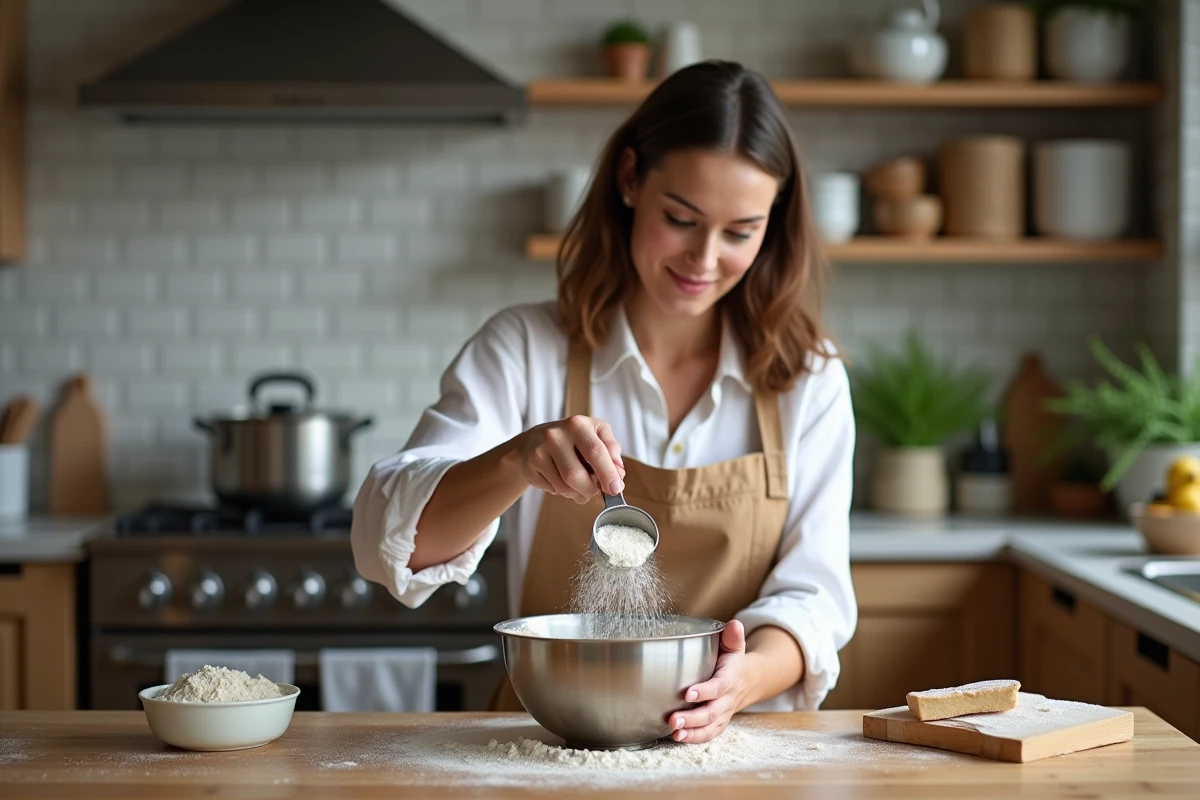
300 grams of water corresponds to 300 milliliters, but the same amount of flour occupies a very different volume. The ratio between grams and milliliters varies according to the density of each ingredient and can lead to significant errors during preparation. Some products, like powdered sugar or oil, also show significant discrepancies between weight and volume. Specific tools or conversion tables are recommended to avoid approximations, especially when making precise recipes.
Why 300 g does not always equal 300 ml: understanding the difference between mass and volume in cooking
The gram does not hold sway over the milliliter, especially in cooking. It is often thought that 300 g equals 300 ml, but this shortcut only holds true for water, the exception that proves the rule. Because as soon as we change ingredients, everything gets muddled: each product carries its own density, an invisible but decisive figure.
Behind every scale, there is a balance to find. For flour, 300 g spreads over 510 to 545 ml depending on the type and packing. Oil, being lighter, is around 326 ml for 300 g. And if we switch to milk or honey, the discrepancies widen. The conversion is never automatic: it requires method and precision. Recipes where everything hinges on accuracy, like a light sponge cake or a fine cream, do not forgive approximation.
Volume (ml) = Mass (g) / Density (g/ml). This is the formula to keep in mind, the one that draws the line between a messy dish and success. Professionals do not shy away from it, and for good reason: a few milliliters too much or too little, and the texture is affected.
To navigate error-free between mass and volume, a reliable reference remains the resource the correspondence of 300g in ml. It details, ingredient by ingredient, what 300 grams really means on the table, and provides a solid foundation for adjusting each recipe.
300 g in ml according to your ingredients: concrete examples and tips to avoid mistakes
Conversions change according to the nature of the product used. Here are some concrete examples to help you easily find your way:
- Flour: for 300 g, count about 510 to 545 ml. The density varies, so avoid packing the flour and level it well in the measuring cup.
- Oil (canola, olive…): with a density of about 0.92 g/ml, you get about 326 ml for 300 g. Temperature can influence the result.
- Milk: its density hovers around 1.03 g/ml. Therefore, 300 g corresponds to 291 ml. A detail that matters in a custard or a flan.
- Honey: the density of honey (1.4 to 1.42 g/ml) gives between 211 and 214 ml for 300 g. Use a spatula to recover all the product without loss.
For a reliable conversion, always ask the same question: “What is the density for this ingredient?”. Look for the information on the packaging or a reliable resource. With this reflex, it is impossible to go wrong. Precise cooking is for those who do not leave room for approximation, a detail that changes everything at the moment of truth.

Conversion tables and practical tools: save time and succeed in all your homemade recipes
Conversion tables are there to simplify life: each ingredient, each density, the exact correspondence between grams and milliliters. On paper or online, these tools limit unpleasant surprises and reduce the risk of error. It is impossible to confuse all-purpose flour and powdered sugar when you have the references at hand.
Get into the habit of using an electronic scale for weighing, and a measuring cup for measuring volume. For those who cook by eye, there are always some common references to know:
- Tablespoon: 15 ml
- Teaspoon: 5 ml
- Cup: 250 ml
- Yogurt pot: 140 ml
- Mustard glass: 200 ml
Convenient for quick measurements, but to be used with caution: accuracy is not their strong suit. In contrast, a digital converter takes every difference into account and delivers the result without mental gymnastics. Between the rigor of the scale and the efficiency of these tools, there is no more doubt: each ingredient will be measured to the nearest tenth, and your dish will only benefit from it.
Ultimately, succeeding in a recipe means accepting that approximation has no place when precision matters. When it comes out of the oven, it is the dessert, the sauce, or the dough that stands out, and the difference is glaring. There is no negotiating with accuracy.