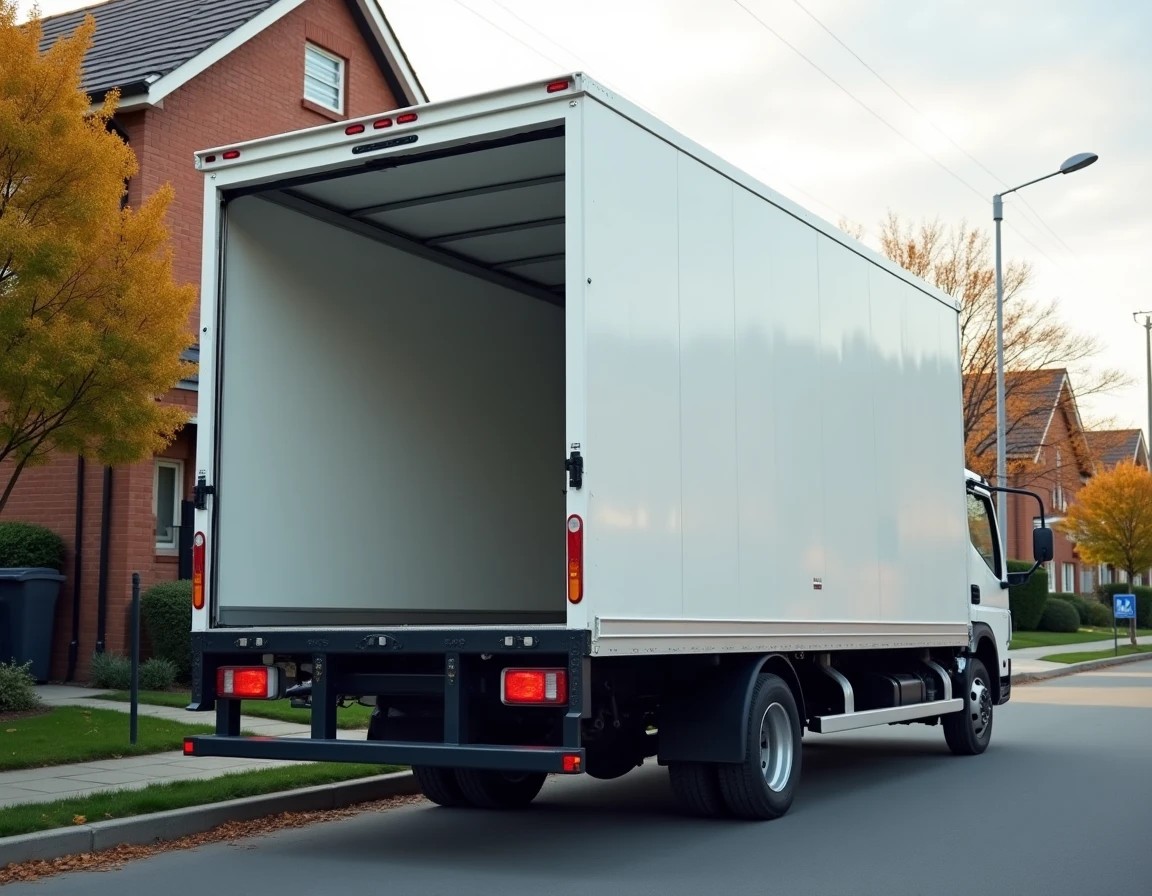
The 15 m3 truck occupies a special place in the range of utility vehicles. It represents the largest loading volume accessible without crossing the threshold of heavy vehicles, making it a technical step that is important to understand before planning a move or transporting bulky items. What are its actual interior dimensions, and what can be loaded in it?
Useful interior dimensions of the 15 m3 van: length, width, height
Online articles often mention the gross volume “15 m3” without detailing the interior measurements. However, these measurements determine what can or cannot fit in the box.
| Dimension | Indicative Value |
|---|---|
| Useful Length | approximately 4.30 m |
| Useful Width | approximately 1.80 m |
| Useful Height | approximately 1.90 m |
| Total Volume | 15 m3 |
These reference dimensions (L 4.30 x l 1.80 x H 1.90 m) correspond to recent vans offered by general rental companies. They vary slightly from model to model but remain within this range.
The useful length of 4.30 m allows for the loading of long furniture: a three-seater sofa, a traditional sideboard, or a 200 cm bed can fit without difficulty. The height of 1.90 m allows for a standing wardrobe to be slid in most cases, provided its dimensions are checked down to the centimeter.
Knowing the exact dimensions of a 15m3 truck avoids unpleasant surprises on loading day, especially for non-dismantlable furniture.

License B and GVW: the real regulatory advantage of the 15 m3
One point that rental product sheets rarely address in depth: the 15 m3 van is the largest utility vehicle that remains below the 3.5 tons GVW (gross vehicle weight). This limit has two direct consequences.
- The vehicle can be driven with a standard B license, without additional training or a heavy vehicle license.
- It falls into class 2 for highway tolls, which is a significantly lower rate than for trucks of 20 m3 and more, classified in category 3.
- The traffic rules remain those for light vehicles: access to city centers, parking in standard spaces (subject to height restrictions).
Switching to a 20 m3 truck means moving into the heavy vehicle category, with increased toll costs, traffic restrictions on weekends in certain areas, and sometimes the requirement for a C license. The 15 m3 is therefore a strategic ceiling for those who want to maximize the transported volume without administrative constraints.
Actual loading capacity: from T2 to T4 depending on optimization
Older content systematically associates the 15 m3 with an F2 or small F3 type apartment. This estimate remains cautious. Current rental companies are expanding the range to larger accommodations, up to T4, provided that packing is optimized.
Housing from 40 to 70 m2
A two to three-room apartment (40 to 70 m2) generally fits in one trip. The volume is sufficient for a sofa, a double bed, a table, several boxes of books and personal effects, a refrigerator, and a washing machine.
Beyond 70 m2: a loading that requires preparation
For a T4, loading everything in one trip assumes disassembling bulky furniture, stacking boxes methodically, and utilizing all the useful height. Every centimeter of unused height reduces effective capacity.
Some concrete benchmarks to assess filling:
- A three-seater sofa occupies about 2 m3 when properly secured.
- A standard refrigerator represents around 1 m3.
- A standard moving box (type “book”) is about 0.05 m3, allowing for the stacking of several dozen.
- A two-door wardrobe, loaded standing, takes between 1 and 1.5 m3 depending on its depth.

Comparison of 15 m3 against neighboring volumes: 12 m3 and 20 m3
Choosing a 15 m3 rather than a lower or higher volume involves a trade-off between capacity, cost, and driving constraints.
| Criterion | 12 m3 Truck | 15 m3 Truck | 20 m3 Truck |
|---|---|---|---|
| Useful Volume | 12 m3 | 15 m3 | 20 m3 |
| Required License | B License | B License | C License (heavy vehicle) |
| Toll Class | Class 2 | Class 2 | Class 3 |
| Type of Housing | Studio / T2 | T2 / T3 (or even T4) | T4 / T5 |
The transition from 12 to 15 m3 adds about 3 m3 of volume without changing regulatory category. However, the transition from 15 to 20 m3 changes the game: the additional cost is not limited to the rental price; it includes tolls, insurance, and the license.
For a standard T2 or T3 move, the 15 m3 meets the need without unnecessary surplus. For a well-optimized T4, it remains a viable option. Beyond that, the 20 m3 becomes necessary, but the budget and prerequisites change fundamentally.
The 15 m3 van derives its relevance from this pivotal position: maximum volume in the light vehicle category, sufficient interior dimensions for most common furniture, and controlled transport costs thanks to the class 2 toll. Checking the exact dimensions of the rented model remains the most useful precaution before each loading.