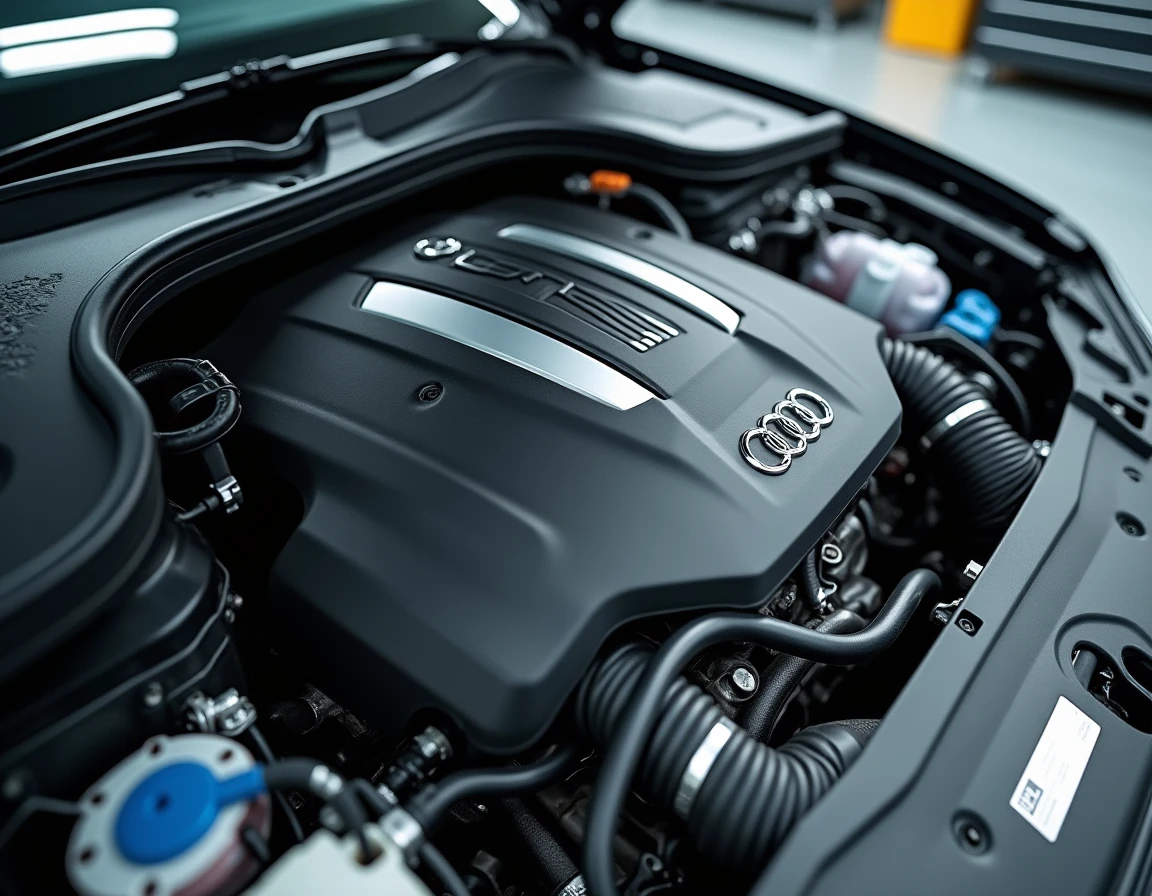
The acronyms TFSI and TSI consistently appear in the technical sheets of the Volkswagen group. The first is associated with Audi, while the second is linked to Volkswagen, Seat, or Škoda. However, beneath these distinct names lies an increasingly shared mechanical base, particularly since the EA888 engine family. Understanding what truly separates them requires going beyond simple acronym decoding to examine engine calibration, reliability history, and commercial positioning choices.
EA888 Platform: the same block, different calibrations
TFSI stands for Turbo Fuel Stratified Injection, while TSI refers to Turbocharged Stratified Injection. Both refer to a gasoline engine with direct injection and turbocharging. On the 1.8 and 2.0 blocks of the EA888 gen 3 generation, Audi TFSI and VW TSI share the same mechanical base: block, cylinder head, direct injection system, and turbocharger are identical.
The difference between Audi TFSI and TSI then lies in peripheral elements. The calibration of the engine mapping, the cooling circuit, and certain ancillary components vary depending on the model and brand positioning. A 2.0 TFSI installed in an Audi Q3 does not deliver exactly the same throttle response as a 2.0 TSI in a Golf GTI, even though the heart of the engine is physically the same.
This technical convergence is a recent development. The first generations of EA888 (gen 1 and gen 2) exhibited more divergences in internal components, making the TFSI/TSI distinction more tangible from a mechanical standpoint.

TFSI and TSI Reliability: Divergent Correction Trajectories
Sharing a platform does not imply an identical reliability history. In the first generations of EA888 blocks (gen 1 and gen 2, roughly covering the first half of the 2010s), several Audi TFSI engines are identified as problematic in recent buying guides. Oil overconsumption, premature wear of the timing chain, and valve carbon buildup from direct injection: these defects are documented and recurring.
The point that deserves attention concerns the pace of corrections. In several cases, the TSI versions installed in Volkswagen benefited from modifications (piston references, rings, or chain tensioners) earlier in their production cycle. At the same generation level, some TFSI engines remain riskier for used car purchases than their TSI counterparts.
This discrepancy is partly explained by production volumes. Volkswagen models, sold in larger numbers, generate quicker field feedback, which accelerates the identification of defects and the implementation of fixes. Field feedback diverges on this point across markets, but the general trend is documented by VAG group specialists.
Points of Caution When Buying Used
- Check the exact generation of the EA888 block (gen 1, gen 2, or gen 3) rather than relying solely on the TFSI or TSI badge
- Request the oil consumption history and any recalls or timing chain replacements
- Prefer gen 3 blocks, where the main defects of previous generations have been corrected in design
- Consult specialized VAG forums to cross-check feedback on the specific engine code of the targeted vehicle
TFSI on Audi Plug-in Hybrids: a Changing Label
In recent years, Audi has used the TFSI e label to designate its plug-in hybrid powertrains. The turbocharged direct injection gasoline engine remains present, but it is coupled with an electric block and a rechargeable battery. This extension of the label blurs the initial interpretation of the acronym.
The TFSI e no longer refers to a standalone engine but to a hybrid powertrain. The thermal block retains TFSI characteristics (direct injection, turbocharging), while operating in tandem with an electric motor that engages at low speeds or in zero-emission mode over short distances.
Volkswagen, on the other hand, has not adopted the same convention. The manufacturer’s plug-in hybrids bear different names (eHybrid, GTE), without using the TSI acronym in their commercial designation. This divergence in marketing communication increases confusion for buyers comparing ranges within the group.
Consumption and Maintenance: Variations Related to Model, Not Badge
Comparing the combined consumption of a TFSI and a TSI of the same displacement and generation does not reveal a structural difference related to the badge. The measured differences depend on the vehicle’s weight, its transmission (front-wheel drive or quattro), its aerodynamics, and the specific calibration of the mapping.
An Audi A3 Sportback 35 TFSI and a Golf 1.5 TSI share the same base engine. The difference in combined consumption depends on the chassis and equipment, not the designation. A model equipped with quattro all-wheel drive will consume more than an equivalent front-wheel drive model, regardless of the TFSI label.
In terms of maintenance, oil change intervals, oil specifications, and wear parts follow the same logic. The engine code (EA888, EA211, etc.) determines the maintenance plan, not the commercial badge.
What Really Matters for Maintenance
- The exact engine code (visible on the registration document or engine plate) dictates compatible parts and service intervals
- The generation of the block conditions the likelihood of known defects (chain, rings, turbo)
- The type of transmission (front-wheel drive or all-wheel drive) influences the complexity and cost of routine maintenance
The distinction between TFSI and TSI is primarily a communication choice within the Volkswagen group. For a buyer, the engine code and the generation of the block are far more reliable indicators than the badge affixed to the hatch. Consulting the complete technical sheet and cross-referencing feedback on the specific engine of the vehicle remains the safest approach before any purchase.